Thursday, 24 May 2012

FFS the FTT is not FFP

What a difference a day makes.

In the rapidly unfurling madness that hs gripped the Eurozone, the summer may prove to be a cataclysmic season. Yesterday European finance ministers gathered to thrash out plans for growth and investment ahead of an EU summit at the end of June. It was an opportunity for new French President to bring the the table the concept of Eurobonds - a policy idea on the back of which he competently rode to election victory. Yet the concept of drawing up co-liability between Eurozone member states for debt, as such becoming eachothers' guarantors, has never sat easily with the Germans. This is despite the fact that simply sharing in a currency is enough to allow economic contagion to rip through the continent like an Australian bush fire.

Last year, 25 of the 27 member states of the EU signed a fiscal treaty. Only the Czech Republic and the UK refused to be signatories. The treaty essentially outlined austerity measures that all member states agreed to in order to try to protect the fragile economic situation in Europe from further sharp blows. Yet also in this treaty was a proposition to add the Tobin Tax, or Robin Hood, tax, on financial transactions. The concept that the tax robs the rich (bankers) to give to the poor (Brussels) is a twisted distortion of what would likely be the outcome. As we all know, incurred costs are more often than not passed down to the consumer. In this instance, all members of the general public with bank accounts. The other potential repercussion is the mass exodus of the banking sector from the European Union to more liberalised financial sectors in other countries, such as Zurich or Hong Kong, This of course would result in a disproportionate blow to the UK, who houses more than three quarters of the banking sector of Europe in The City of London, as well as many corporations around the world. Were these institutions and multi-national conglomerates to up and leave, the impact on the UK economy would be substantial. The contribution to GDP of the financial sector in the UK is hugely significant, as well as the jobs it provides and the capital that flows to the country.
And so for this reason, in December last year, the UK vetoed the treaty. As a result of not being able to achieve unanimity, such a schismatic legal change could not be made under EU terms. In effect, the withdrawal of the UK ace should have brought the house of cards down

And yet it hasn't. For yesterday the European Parliament voted 487 votes in favour, 152 against, with 46 abstentions for the Podimata report which paves the way for the Financial Transactions Tax to be levied.

An amendment to shoot down the report brought forward by the ECR group, to which the Conservative Party belong, was strongly defeated, leaving the UK Government with little room for manoeuvre. The question now is whether the UK Government can do anything at all to prevent the FTT from coming into affect. 

The proposal is for both sides of the transaction to be taxed. Those who signed up to the treaty vetoed by the UK Government on the basis of this tax would benefit from a reduction in EU contributions. The UK veto has as such been rendered useless, placing the onus on the UK taxpayer to pay the tax on all transactions for member states who had signed the treaty, yet without receiving the benefit of a reduction in EU contributions. 


The tax essentially allows the EU to finance itself directly from taxpayers’ pockets  - and yet without any recourse to a public vote. Giving the EU tax raising payers without any democratic scrutiny is utterly unacceptable and is also the final step in making the European Union a federalised super-state.

In theory the tax cannot be approved without the unanimous backing of the European Council. Surely the British vote would most steadfastly be against the introduction of the FTT. However the Parliamentary report calls for the implementation of the tax by the beginning of 2015 "even if only some member states opt for it".

Nine countries have come out in favour of the tax including Austria, Belgium, Finland, France, Germany, Greece, Italy, Portugal and Spain, with it being labelled as the main route of exit from crisis. Yet rapporteur Anni Poadimata's view that it would brung a "fairer distribution of the weight of the crisis" is utterly skewed. The majority of the weight of such a tax would be carried by the UK, and it would appear the intentions are to use the extra finances to shore up the single currency.

The FTT is not FFP

The Financial Transactions Tax is not Fit For Purpose

A report by the Institute of Economic Affairs warns agains the dangers of a Financial Transactions Tax. In it, it is suggested that


  • An FTT can be imposed with varying effects depending upon how many other governments do so at the same time. A purely EU FTT would see much trading leaving the EU, as happened to Sweden when it unilaterally imposed such a tax in the 1980s and 90s. A global tax would not have the problem of trading moving but would still have all of the other associated problems
  • There would be no net revenue. While there would be revenue from the tax itself there would also be falls in revenue from other taxes. The net effect of this is that there will be less revenue in total as a result of an FTT
  • The FTT simply means it would be the EU's own money to spend as they wish. The revenues from the FTT would be designated as the EU’s ‘own resources’, that is, money which comes to the centre to be spent as of right; not, as with the current system, money begrudgingly handed over by national governments. The EU bureaucracy therefore has a strong interest in promoting such a change. What’s in it for the rest of society is harder to spot.
  • It will be the taxpayer who carries the burdern. All taxes and any tax, means less money in the wallet of some live human being. The first and great lesson of tax incidence is that taxes on companies are not paid by companies. They are not, despite legal personality, live human beings and therefore cannot carry the ultimate burden of any tax. With the FTT the one place we know the tax cannot fall is on the banks. Banks are corporations and corporations cannot bear the burden of a tax; it has to be some human being. Some part falls upon capital, making raising capital more expensive. This, in turn will affectworkers’ wages: more expensive capital leads to less of it being employed. Yet this does not mean bankers earning less: it is the workers who earn less as a result of less capital being employed. The second part is the incidence upon the users of the financial markets: a fairly obvious result of a transactions tax. Pensions would yield lower returns, partly as a result of lower share values as a result of the tax and partly as a result of paying the tax itself. The FTT would thereforeimpact upon all users of any financial instrument.
  • The loss in GDP as a result of the tax is larger than the revenues raised from the tax. The total incidence, the total lost from all pockets, is higher than revenues and thus the incidence of the tax is over 100%.
  • A transaction tax would increase, not decrease volatility. Since an FTT would decrease the size of the financial markets, prices would jump around rather more than they do at present - completely the opposite of what certain supporters of the FTT suggest.
  • The markets that do high volume, low margin trades  would be affected by an FTT such as the foreign exchange (FX), futures, options and stock markets. None of these markets failed in any manner in the recent or current troubles. So the FTT doesn’t even work as a way of avoiding the recent financial crash: for it taxes the things that did not cause problems and would not make much difference to those things which did.
 The situtation in Greece is appalling, with drugs at an all time low as a result of deep austerity measures cutting healthcare budgets and forcing families onto the streets. The country is on the brink of a healthcare crisis, with panic spreading among high risk patients who fear they will have no access to life saving drugs. One healthcare profssional predicts that within two weeks, if the European Union does not grant Greece the loans it needs, chaos will erupt on the streets. Another healthcare worker, a cardiologist, has told the press of his horror at treating mean, women and children for sickness due to eating out of bins. A member state of the European Union is quickly degrading into scenes of a third world dictatorship.

Yet the money currently being dangled in front of Greece would not restock pharmacies.Instead it would be placed into a separate account, inacccessible by public service financiers, to simply pay off interest of Greek debt. In return for the loan, further cutrs would have to be implemented by the Greek Government - itself non-existent after dramatic election results left no one party with a big enough majority and 70% of Greek people voting for manifestos that promised an end to the crippling austerity measures.

It is without doubt a crisis situation in Greece, and the country desperately needs money. The causes of the problem, the finger pointing, the accusations of profligate waste during boom years, have been rendered vacuous. These are real people's lives. But what people must understand is taxing the banking sector is not going to directly resuce Greece. Far from it. It will line the pockets of Brussels and enable them to continue with their single currency project while using their new found security as a mallet with which to strike the Greeks into submission.Where they stand now, a Grexit could seriously harm the single currency, removing some of the might from Germany's arguments. Yet if the FTT is pushed through, Europe would be once again armed with power. And this time, not just the war-tanks of legilsation that have ridden roughshod over national interests. They would also have a constant and controlling source of income.An FTT will not reduce volatility, it will increase it. It would shrink those parts of the financial markets which did not in any manner contribute to these problems. It would increase revenue collected directly by the EU - as the Union's first tax raising power, while reducing total national revenues by shrinking the overall economy. Meanwhile those who would carry the economic burden of the FTT would be workers and consumers iplacing dependency straight back into the hands of the federalised superstate.

Over the next few days decisions made by financial and political leaders in all member states could have a profound impact on the future shape of Europe for all. With picture changing so rapidly on a daily basis, who knows what the autumn will bring.


Tuesday, 15 May 2012

By Zeus!

In an ironic twist of events, Francois Hollande's much anticipated meeting with Angela Merkel to forge a new cooperative dominion over the Eurozone was halted after his plane was struck by a bolt out of the blue.

Could that be an act of Zeus?

http://www.bbc.co.uk/news/world-europe-18078845

Climate Change in the Political Sense


For more than four years now I have been writing articles on the problems in the Eurozone. It is becoming a rather wearisome subject, despite the twists and turns in the plot line. That’s because we all know how the book ends.
But what we don’t know is what story follow up books will tell. For this first time European Central Bankers have explicitly discussed a Greek exit. Over the course of the last two years I have challenged the Commission President over the possibility of Greece being booted out of the single currency. He repeatedly denied that this was even a possibility. I wrote to the Chancellor of the Exchequer and the Minister for Business in the Welsh Government to enquire whether an impact assessment had been drawn up and how we would deal with the implications of overnight chaos in the Eurozone. The response was one of silence.
It would seem though that the day for serious scrutiny has come. Markets have plunged in response to the new fears that Greece will run out of money to pay its creditors as early as next month, with reports from The City that some companies have already asked for drachma to be included on their systems. Economists fear that a Greek exit would result in runs of Spanish debt, forcing them to seek bail outs when the reserves for such a crisis would not even begin to meet the needs of contagion spreading to the EU’s fourth largest economy. Yet any crisis in the Eurozone jeopardises our own economy. Fragile Ireland just across the water would suffer under a collapse of the single currency. Remember that it was UK sterling that underwrote Irish debt, while Ireland remains tightly bound to Wales in terms of trade. Meanwhile the Eurozone remains the UK’s largest single export market.
The other consequence of economic misery however is more worrying. As demonstrations in Spain are revealing an increasing appetite for protest, Southern Europe is preparing for a summer of discontent from across the political spectrum. Fifty thousand “Indignants” gathered in Madrid’s Puerto de Sol at the weekend. Suggestions that the Greek Parliament, having been unable to form a government after recent elections, may continue with a technocratic government that would be obsequious to Brussels would be met with bloody protest. What was witnessed in the Arab Spring could soon be taking place on the continent. The last time capitalism and democracy went into retreat in Europe the results were terrible. Barely eight years after the last time European banks collapsed, the continent was plunged into a series of civil wars and nationalist struggles that erupted into World War II.

Thursday, 10 May 2012

Patently obvious

New EU laws are looking to broaden the scope of patenting what are called “essentially biological processes”

What is meant by this is selective breeding and crossing for example, to create new strains of plant or genetically selected animals.

However the process used is rather more natural than simply a laboratory based exercise - so how does one copyright it?

Currently multi-national companies are able to use patenting laws to monopolise new breeds, often for the purposes of agriculture. There have been some recent high profile cases concerning some of the biggest agricultural giants patenting breeds of tomato and broccoli, preventing competitors from growing similar strains. 

But should Europe have the competence to decide what gets patented and by whom?

Currently it is up to nation states to make such calls, and with so many social and moral implications of breeding new animals and plants, be it for consumer purposes or scientific experimentation, it is not right that the EU should have the power to decide. We must equip national patenting offices with the powers to discriminate in the UK who owns the intellectual property of what.


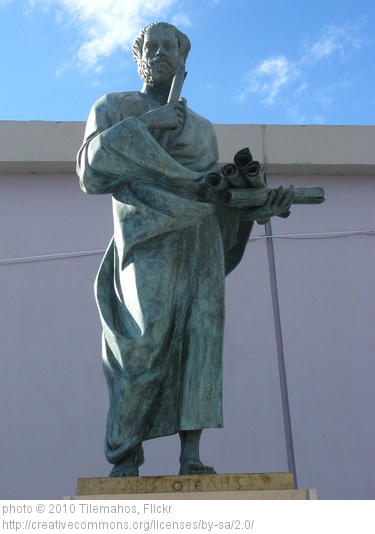
Greek Enlightening?

There is something so poignant yet with an irresistibly aesthetic in the fact that the seat of ancient Western philosophy is currently the seat of political and economic disruption in Europe.

So much of what we have today - the structure of society and politics and the words we use to discuss it - found origins in Greek philosophical scripture.

From Plato's Republic to Aristotle's Politics, Greek thinkers conceptualised and theorised the ideal structure of society and role of law more than two and a half thousand years ago. What would they have to say about what has happened in Greece, and what would their opinion be on the European Union?

Looking at Aristotle's Politics, it is important to highlight that the philosopher believed human kind by nature to be a social and thus political animal. He did not mean that everyone wished to be out canvassing for this party or that, or even sit on councils or governing panels. As a biologist Aristotle was keenly interested in categorising species and observing how they lived. He observed that mankind had a heightened moral code rarely seen in other species, which lended itself to the creation of a complex social context. As such, he determined that the Polis, or city structure, was engineered by man to enable the species to flourish or achieve Eudaimonia.

In order to make the Polis work, everyone, he believed, should be educated with an eye to the constitution. For Aristotle, being co-citizens was not merely about mutual cohabitation under the same set of laws, for this was a matter of justice alone. Instead being a citizen was about participartion in rule and political deliberation.

However this did not necessarily constitute what we term democracy today. For Aristotle, extreme democracy would lead ultimately to anarchy, a theory borrowed from Plato's Socratic works. Instead, Aristotle felt that the rule of law was structured upon socio-geographic properties. Different societies, depending upon topographic features and thus industry and agriculture, and cultural relativisms, prospered under different systems, from extreme democracy to oligarchy to monarchy. Being the philosopher who defined value in his Nicomachean Ethics under the system of the Golden Mean (where a balance must be sought between opposing factors, such as an equilibrium between cowardice and foolhardiness) he saw perfect governance as a balance between monarchism, oligarchy, democracy and other social structures.

However what was vital in this Pragmatic Utopianism is the underlying belief that political rule must be in the interest of the ruled, and as such, abide by a teleological sense of aiming ultimately for what can be deemed 'good'. In order to achieve this, Aristotle envisaged an upper limit to a macro-governance of around one hundred thousand people. Within this subframe resided other micro-governed units, all the way down to the family home where he saw the relationship between man and wife as somewhat political in its ideal operation.


So what would he make of the European Union, and what would he say about the current situation in Greece?

“Polity” for Aristotle is the word to indicate rule by the many in what he defines as the correct system of government. By contrast, he refers to rule by the many in a diverging and thus “erroneous” system as “democracy.” Polity is therefore midway between democracy and oligarchy. Critics would argue that what we are currently witnessing in Greece is bordering on oligarchical rule, or quasi-democratic governance, where stringent measures laid down by ruling factions such as the EU, IMF and European Central Bank or the Troika are not taking into consideration the will of the people.

Aristotle argued that mistreating the people would lead to the overthrow of the oligarchy and thus the establishment of democracy. Perhaps what we are seeing at the Greek ballot box is an increasing mistrust of the authorities that have governed Greece since the outbreak of financial crisis and will lead to a European Spring, where psephological rebellion will overturn the powers held by Brussels.

Interestingly however, Aristotle also argues that erroneous systems of government are necessarily subsequent and not prior to good systems of government. Using this model perhaps Aristotle would argue that as an original concept, the European Economic Community established more than 50 years ago was just in its aims and provided a valuable function. But the system of governance that has developed, as derived from a proper and sensible model, has become distorted by influential factors that disallow the right form of government to prosper. Aristotle might perhaps perceive the biggest influence and thus corruption of EU level politics to be the size of the multitude it governs.

In Aristotle's writings, a city-state must be populous enough to be self-sufficient, but too large a state cannot have an easy system of governance as it cannot be effectively managed, with inadequate representation of or communication with its subjects. However Aristotle does not distinguish between foreign born and original residents. What is important, he believes, is having an appropriate number to be able to forge participation across society.

As such Aristotle also sets great store by education, debate and social inclusion in discussions and inquiry on a governmental level. One would imagine he would perceive the EU as not only too far-reaching in its geographical expanse and ambition, but too opaque, and as a product of its vastness, incomprehensible to its population.

What might be suggest in order to divert crisis from Greek shores?

It is highly likely that he would be an advocate for Greece leaving the EU. He might even go as far as to purport restructuring the governance of Greece into smaller, devolved democratic provinces within which nuclear self-sufficiency could be achieved in order to restore the competitiveness of the economy.

Despite unwittingly scribing a number of concepts and political theories that have been embraced by Brussels, it is hard to imagine that Aristotle would support the structure of the EU as it is today. His belief that different systems of governance are appropriate for different topographical regions, each with their own set of idiomatic concerns, would likely make him a supporter of the nation state over and above supra national entities. He would almost certainly disapprove of Common Agricultural Policy!

Under Aristotelian predictions, the EU would be setting itself up for a fall.
Indeed, recent elections in both Greece and France have witnessed the public making it clear that they no longer have faith in their ruling parties. The question that has been raised as a result of the recent polls is whether or not the EU will heed the warning. The people have spoken - but will they be heard?

According to Aristotle, the greater number of people living in poverty creates a sizeable enough catalyst to act as a stimulus for change. Levied against the inertia of a ruling class who do not allow for the participation of the greatest possible number of citizens, the result is a clash out of which democracy (or perhaps using a different term, anarchy) will come to the fore.

We have witnessed this in the Arab Spring, despite the development in that particular context yet to draw to a final conclusion.

Perhaps we will witness it in southern European states?

One thing however would be interesting if The Republic and Politics became the text books for a European constitution. Under an Aristotelean or Platonic model of governance, Barosso and Van Rompuy may well be exiled abroad and likely replaced by the likes of Roger Scruton,  A.C. Grayling or even Stephen Hawking.  We could call this new system of rule EUdaemonia.


Wednesday, 2 May 2012

The European Spring

It's not often I read an article in The Guardian with such zeal, especially not an opinion piece.

But today's column by Costa Douzinas, a professor at Birkbeck University in London who has authored and co-authored texts examining the philosophical underpinnings of law making such as human rights, was interesting indeed.

He talks about the possibility of a European Spring of revolution with forthcoming elections in France and Greece. We also have the English local elections tomorrow while Germany will see whether Merkel's leadership amidst ongoing crisis in the Eurozone retains kudos among the voterate. There is also the matter of a collapsed government in the Netherlands and forthcoming local elections in Italy.

The juxtaposition of polls in France, Greece, Germany and the UK alongside ongoing battles to save the single currency couldn't be sweeter for a political theoretician. It would appear in France that Nicholas Sarkozy may become a one-term president and yet another victim of the financial crisis as the public turns towards socialist Hollande's rhetoric against austerity rather than keeping faith in the Merkozy strategem that has so far dominated Eurozone fiscal policy.

Meanwhile, the general election in Greece will be the public's first opportunity to show through the ballot their verdict on their country's financial collapse, and it is likely we will see a surprising result that will prevent either of the two main parties from the past four decades gain an outright majority.

In Italy, local elections will act as litmus for the parachuted-in technocrat Mario Monti who replaced the disgraced Berlusconi last year, while a key regional election in northern Germany in Schleswif-Holstein will determine whether Merkel's popularity and reputation are finally beginning to falter despite relatively secure German faith in her competence to date.

Regarding the run offs for Presidency in France, many newspapers have reported Merkel's open opposition to her old ally's contender. The German Premier has criticised Hollande's posturing against the ongoing austerity programme that has largely been coordinated by Merkel and Sarkozy, threatening to rip up the deal and demand a re-write, a move that many believe could topple the powerful axis of Franco-German driven leadership of the Eurozone and potentially lead to a free-for-all across single currency members at a time when the leadership for a number of countries is set to change. Euroscepticism has crept into manifestos from left to right. What, or more to the point, who, results from elections in Greece is therefore potentially the first dramatic change of power and sentiment that will have been observed in a European country since the outbreak of the Euro crisis.

This is essentially what Mr Douzinas is warning, although unlike a number of other commentators, leaping to the defence of current ruling centre-right governments, he suggests it is the far left, and not the far right, who would become the decision makers in this keystone member state. However he does betray his concern that

"Part of this picture – its most worrying aspect – is the rush to the right by mainstream politicians who, imitating Sarkozy, compete to display their nationalist credentials. Coalition ministers Michalis Chrysochoidis and Andreas Loverdos have spread panic about immigrants as criminals and carriers of infectious diseases, and have set up detention camps in order to contain this "threat"...Meanwhile Athens' Mayor Kaminis has, with Chrysochoidis, organised campaigns to "cleanse" the city of migrants, while the coalition plans an anti-immigration wall on the Greco-Turkish border."


It's a highly interesting observation and one that we have seen mainstream media across Europe discuss with regards to elections in all of the member states.

What we need to address is the unspoken reality of both the creation of fiscal crisis and the subsequent way through the mess.


The majority of countries struggling under alarming debt have reached this stage due to high structural deficits; that is, essentially, the mathematical problem that the cost of running public services afforded by government borrowing far outweighs the income potential of the country in question.

Many theorists have come up with simple studies that support various ideas relating to financial crisis, many of which newspapers are not shy to publish.

I have read articles that muse over the fall in birthrate during depression times, the increase of marriage and reduction in divorce, and many other variations relating to consumer trends, from holidays to hoummous, to abandoned pets and soaring university entrance in countries with high youth unemployment.

Over all, a general picture being painted is that humans, on a collective subconscious level, realise the need to club together resources and reduce financial burden in periods of economic decline.

It surely makes sense. Animals living in the most extreme environments containing minimal resources often betray similar characteristics. Penguins for instance have only one mate, forge a large community and give birth to just one baby each. In boom times, certain species will see propogation exponentially increase as both survival rates soar and reduced competiton factors in its influence, thus the converse is likely to be true when the situation is reversed.

Something else that is true however, is that in times of scarcity, a natural social collective in the animal kingdom is ever more likely to fight off the threat from co-existing groups of the same species. When everyone is competing for the same resources, the tendency to share is greatly reduced and competition over what is available intensifies.

It is hardly surprising then, that in the midst of a financial crisis, anti-immigrant rhetoric also intensifies, yet rather than acknowledging the evident reasoning for this and working to satiate public concern before it topples over into xenophobia, governments continue to fail to address the problem.

It is not "racist" to determine that your nation's services and resources can only stretch so far, particularly during a time of struggle. This attitude does not betray latent opposition to other cultures or nationalities, nor should it suggest xenophobia. What it does do however is reinforce the concept of nationhood, but what is one to expect when the perceived borders of democratic control are divvied up along national frontiers? If those lines were  instead drawn macro-regionally, between counties for instance, loyalty would be emboldened on a smaller socio-geographic scale.

Perhaps the commentators, and Mr Douzinas, is right, and what is happening is a creeping empassioned attack based upon ethnicity and ethnography rather than on more level handed demography.

If the rhetoric from the two Greek coaltion ministers is true and is not based upon any conceivable proven fact, then the problem is severe when competing parties are reduced to conflating race with liability for being a vector of disease. Indeed such a supposition is the thin end of a wedge, and something I oppose from the bottom of my heart. However, and I would tentatively observe rather than ordain here, the notion that it is not uncommon for anybody coming from outside of a community, be it a returning native or a newly arrived foreigner, to bring with them the threat of an infection that is perhaps uncommon in a particular society, and thus potentially poses a greater threat.

I find myself torturously re-reading this to ensure that what I have written comes across as evidently objective and reasonable, lest to avoid any sort of ill intentioned criticism. But the point is, I shouldn't. This is afterall why we have jabs before holidaying in foreign countries, or have to present a yellow fever certificate for entry into others.Nobody would call such policy making racist or xenophobic. It is common sense. Yet the very fact that it has become so difficult to even word certain topics, being careful of references and examples one uses, so as to avoid any possible misinterpretation of offense, has become the root of a very real social and political problem.

Because it has become politically incorrect to talk candidly  about issues such as population size, limited resources, birthrates, immigration, migration and citizenship, voters who are not finding moderate concerns accommodated by the government or the main opposition party are seeking solace in marginal organisations who opportunisticly address such taboos and converet them  into valence issues.

I want to point out here however that the present climate is not just fertile ground for distasteful extremists.

More importantly smaller viable parties who have not had the opportunity to rise due to media control or hereditary voting habits are now finding an arena in which such issues often avoided by ruling parties but addressed on the sidelines are coming to a fore, and it is allowing the public to finally, democratically represent their misgivings in the political fora.

It is not always just a protest vote, but a genuine realisation that there are other political groups out their with sound policy making, fair judgement and very good ideas.

Voting is not like supporting a football team. Certainly when your sports team have a bad season you don't suddenly ditch them and start cheering for the premiership victors. But politics should not be like that. You do not have to vote Conservative or Labour simply because you have done so all your life. You have the opportunity, and dare I say it, the responsibility as an adult with a right to vote, to read through all the available manifestos and make a decision based upon honest and considered calculation.

UKIP are one such party who are on the rise. In all recent polls we are level pegging with the Liberal Democrats if not ahead, but still we won't get the same amount of coverage.

That is because the partisan press in the UK are backing one of the three main parties, and UKIP is a threat to them all. For that reason we are easy to throw stones at. But it is the very misguided critics out there who are quick to raise unsubstantiated and alarmist claims in order to defend the major parties that are actually creating a far right movement by not giving decent and responsible smaller parties like UKIP the platform for debate.

In my view, UKIP are not even on the right hand side of an assumed political spectrum, yet so often we are labelled as "far right" as an excuse to defend the parties that we threaten because they are failing to address voter sympathies. It has therefore become all too easy for issues such as immigration to be conflated with xenophobia, and yet nobody out there knows why.

Why can't we talk about this frankly without feeling worried that we are going to be judged?

Well a political scientist might just flag up similar reasoning to what I have just described. The combination of the mistakes of history and a public sense of guilt becomes easy fodder for political communicators to use to drum up a culture of fear over smaller parties in order to marginalise any party that is a threat to a ruling group. As a result, key electoral issues become matters of dangerous taboo.

If collectively across Europe, smaller, responsible and well-intentioned parties, whether they reside on a fictitious left or a fictitious right, grow in prominence and enable the formation of a European Spring, then I will be happy if it topples the hegemonic might of Brussels - with minimal fall-out.

However if they are not allowed to do this, what we will see is the creation of a blackmarket of political thought where less than savoury ideologies are allowed to prosper.

And so I implore voters across the European Union. Vote wisely, vote sensibly, but vote with your heart and mind. If that means breaking with convention, then have the conviction to do so. For that is the real measure of democracy.


Wednesday, 25 April 2012

I'm not one for conspiracy theories but...

Today the European Commission will announce a 6.8% increase in budget - equivalent to €138 billion extra.

This is truly extraordinary when the majority of member states (25 out of 27, excluding the Czech Repubic and the UK who refused to sign up to the latest 'non-EU treaty' financial pact) are under mandate to enforce austerity measures imposed by Brussels. How then can the EU defend such an enormous hike in its own budget?

The swingeing austerity measures laid out by Brussels are crippling European economies, not saving them, with the constant cutting and adherence to the single currency project proving disastrous for the EU and global economy as a whole.

Today the ONS announced that the British economy shrunk over the last two quarters, plunging us back into recession, with the ongoing Eurozone crisis to blame.

Add to that the news that the UK will pay another £10 billion to the IMF ["It won't prop up the single currency, honest!"] and you've got to begin to wonder, what is going on?

It would appear that Brussels are the very deliberate architects of economic freefall in Europe

It cannot be simply a mistake that the financial crisis is continuing. Perhaps by creating financial disaster in Europe, while copious amounts of money fill up the EU coffers,  fiscal control is able to be diverted to the EU. Where there's money, there's power.

At one point commentators suggested the Eurozone crisis could spell the end for the EU. Far from it. 

If anything, the incredible transfer of power and money to Brussels over recent years as the crisis has taken hold has actually increased the dependence of the majority of member states upon the European Union and its associate bodies, such as the European Central Bank, European Investment Bank and so forth.

Which brings me on to the IMF.

It is shocking to witness the supposedly independent International Monetary Fund supporting the EU programme.

I do not only mean the financial impetus, including the recent call for an extra $430bn (£247bn), to which British taxpayers will contribute an extra £10 billion. 

There is the very tricky matter of the IMF, the EU and the ECB, forming a so-called Troika to effectively run the economies of disaster stricken member states. 

Part of the rules and regulations laid down by the Troika include setting up separate accounts for incoming bail out funds to ensure money is used only to save the Euro through debt repayment and is not spent structurally, in effect, helping the suffering population by a real injection of cash into the national economy.

What we are witnessing is mass unemployment spreading across Europe and a number of economies falling apart, led by an institution designed to "promote high employment and sustainable economic growth, and reduce poverty."

Instead of actually providing financial aid to Greece, Italy, Portugal and so on, the IMF is instead driving funding into bank accounts set up to support the Euro, and thus EU ideology in Europe, while co-authoring regulations which perpetuate the ongoing crisis.

Even the USA has now refused to contribute any more to the IMF, saying they no longer supported the failing efforts to sustain the Eurozone.

What on earth is going on?

It is increasingly apparent that the IMF, led by the former French Finance Minister Christine Lagarde is by no means independent. Of course Lagarde came in after the rather inglorious departure of Dominique Strauss Kahn. It is by no means implausible that his downfall and thus removal from power was all too easy to set up, given the man's penchant for promiscuity. Perhaps that is one conspiracy theory too many - but there are many out there who claim that what happened in that New York hotel room was a deliberate trap.  

Strauss Kahn may just have been a dirty dog who met his inevitable end. Or perhaps he needed to be removed in order to parachute in Lagarde, who would get the job done.

Despite calls from across the global financial sector to dismantle the single currency, instead the IMF have come out and warned against any member state leaving the Euro. It is interesting to point out that France is next in line to enter economic turmoil if the single currency crisis is not tempered. Perhaps the IMF and Christine Lagarde want to evade French financial freefall. But if that was the case, why is the IMF authoring and imposing the austerity measures that are keeping the crisis alive?

It is interesting that while the UK Government publicly vetoed the pact for financial regulation (again, not an EU treaty-despite the 'pact' involving the European Commission, 25 member states, the ECB...- as an EU treaty would have meant referenda across the continent, whose results would likely have seen the democratic obstruction of the pact's political intentions evident to the world stage). However the UK have recently agreed to pay an extra £10 billion to the IMF while our own economy has fallen back into recession, with the single currency to blame for contraction over the last two quarters.

Perhaps my imagination is too creative.

Has Britain, behind closed doors, agreed to support the federal unification of Europe by continuing to fund the bizarre operation being carried out by the EU and the IMF - as long as we can remain on the outskirts?

After all, the money being poured into the Eurozone from the IMF is helping Brussels to actuate these intentions, by breaking down the economies of  member states through destructive austerity measures, and then sweeping to their rescue by promising bail outs in return for  fiscal control by the EU and its related bodies. 

The Eurozone financial crisis is, in effect, enabling the final push for federalism to be made.

Of course in order to achieve this, Brussels needs money to uphold bogus bail outs in exchange for obeisance to their own fiscal mandate. Thus they contrinue to increase the EU budget, but that would not be enough.Brussels needs the IMF to extract money from the global economy to support the operation. After all, financially ruining economies in order to swoop in and take control by offering a golden handshake is an expensive business. So how is the IMF managing to continually pass the collection plate and get other countries to pour money in? Well the ongoing Eurozone crisis is not only a threat to the member states involved. In this hugely interlinked global marketplace, ongoing crisis in the Eurozone is a threat to economies across the world. Perhaps other countries are party to some sort of plan - or perhaps they simply have no choice, as a financial collapse in Europe would mean a heavy toll upon many countries' economic security. Now America has managed to get back on its feet, incidentally by doing the direct opposite of what is being carried out in Europe by providing stimulus rather than imposing austerity, they no longer want to be a part of what is going on in Europe. Although Obama has always championed a more deeply integrated EU, so it may just be that America is turning a blind eye but is unwilling to co-finance the operation any more.

I am sure many readers will be thinking 'what on earth is he on about?'

I am merely playing Devil's advocate -  asking the unanswered questions.

Why is the world allowing this mess to continue?

How is what the EU and IMF are doing not being condemned by the international community - and by this I mean what is overtly taking place, not my conspiratorial postulations.

The formation and fiscal controls of the Troika are perpetuating economic crisis, while 25,000 people in Greece are begging for food, yet no one on the world stage is saying anything.

Europe is not the developing world. It is not an impoverished continent with (manifestly) corrupt governance and (manifestly) tyrannical rule. It is a first world group of countries who should by now be well in the clear after the credit crunch that hit almost five years ago.

This furore has gone beyond a catastrophic mess and incompetent governance.

It is now so absurd that there is a distinct smell of conspiracy about it.